
Overview
Playing Style
-
Power-Focused Playing Style
This style suits players who thrive on generation strong, top end speed through longer and forceful strides. They come with a stiffer boot that efficiently transfers energy into the rink for maximum power with every stride.Acceleration-Focused Playing Style
For players who rely on quick bursts of speed and agile movements to dominate the game, this type of skate is ideal. These offer a moderately stiff boot that balances support with mobility. These these skates, you can swiftly change direction, make sudden moves and accelerate rapidly.
Fit Profile
-
If multiple categories are selected, it indicates the skate is available in or can be molded to different fit profiles.
Low Profile Fit
Narrow forefoot, narrow heel pocket, shallow instep depth and low overall volume.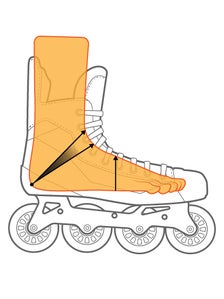
Medium Profile Fit
Medium forefoot, medium heel pocket, medium instep depth and medium overall volume.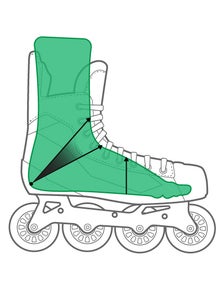
Shop All Medium Profile Skates
High Volume Fit
Wide forefoot, wide heel pocket, deep instep depth and high overall volume.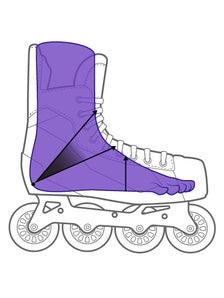
Level of Play Definitions
-
If multiple categories are selected, it indicates the skate is suitable for multiple levels of play.
Recreational-Level Skates
Built for the new-to-hockey player or casual skaters that are looking for an affordable option. These are great starter skates, especially for youth players.
Shop All Recreational Skates.Performance-Level Skates
Designed for players who are confident in their skating stride and are ready to take their performance to the next level. These players are on the rink 1-2 times a week playing mid-to-high level hockey.
Shop All Performance Skates.Elite-Level Skates
Engineered for the best performance, protection, durability and comfort. These players are usually on the rink three times or more a week and are playing high-level hockey.
Shop All Elite Skates.
Cut Protection Level
-
This is the general level of protection against cuts.
- Minimum: Basic protection suitable for competitive play
- Standard: Balanced protection for intense gameplay. Protects against more severe cuts.
- Maximum: Highest level of cut resistance for elite gameplay. Ideal for competitive adult hockey and designed for the biggest and fastest players.
ANSI Rated Cut Level
-
Measures the actual cut resistance of materials based on the ANSI/ISEA 105 standard.
ANSI Level Description Grams of Force N/A No specific cut resistance rating provided by the manufacturer. N/A A1 Minimal protection; withstands light cuts. 200-499 A2 Lower-level protection; resists slightly heavier cuts. 500-999 A3 Low-level protection; suitable for competitive play. 1,000-1,499 A4 Standard protection; defends against significant cuts. 1,500-2,199 A5 Elevated protection for intense play. 2,200-2,999 A6 Extra protection for faster, higher-impact play. 3,000-3,999 A7 Ultra-high protection. 4,000-4,999 A8 Premium protection for all levels of play and ages. 5,000-5,999 A9 Top-tier cut resistance for ultimate protection. 6,000+
Certifications
-
Indicates compliance with safety standards and regulations for hockey gear.
- USA Hockey: Approved for play under USA Hockey regulations. Ensures gear meets safety standards for organized play in the United States.
- BNQ: Certified by the Bureau de Normalisation du Quebec for cut-resistant hockey gear. Required for players in Canadian Minor Hockey leagues to ensure on-ice safety.
- CE: Meets European safety standards for protective equipment. Designed for compliance with regulations across European leagues and recreational play.
Like a surfer seeing a shark’s fin in the distance, the Easton Mako II Hockey Stick will be sure to scare goalies the same way. Easton took an already proven stick to the next level with some key upgrades making this Mako II stick lighter, stronger and more responsive. The shaft is now constructed of their new Uni-Carbon System. This system provides the shaft with more strength, a decrease in overall weight and improved energy transfer by aligning the fibers in the same direction unlike other sticks on the market. The Easton Mako II has double concave sidewalls with square corners that works with the textured surface of the shaft and the grip coating to make for a solid and natural contouring hold.
The blade now has four internal ribs compared to last year’s Mako that had just two internal ribs. With the additional two ribs, a stiffer and more durable blade was achieved while making it even lighter than before too! The Micro-bladder Process helps to keep a great puck feel by making the blade as consistent as possible, meanwhile a 3K carbon weave was wrapped around the entire blade in order to provide excellent responsiveness and durability.
- Heritage: 2012 Easton Mako stick
- Level of Player: Ideal for the advanced to pro level of player
- Construction: Fused one-piece
- Shaft Dimensions: Double concave side walls/Square corners
- Flex Point: Low kick
- Weight: 429 grams (based on E4 curve, 85 flex)
Specifications
- Construction:
- Uni-Carbon System
- Universally aligned fibers throughout the shaft to provide a stronger and lighter shaft while improving energy transfer also
- Flex Profile:
- Tuned taper section built with Easton's Elite Stiffness Profile to pro specs - Offers quick shot release and controlled puck reaction
- Geometry:
- Double concave side walls, and square corners
- Grip:
- Grip coating
- Blade:
- 3K woven carbon material
- Multi-rib design
- Four internal ribs keep the blade stiff and accurate throughout every moment of the shot
- Prevents the core from breaking down
- Solid dense lower core keeps the blade in contact with the puck longer resulting great puck control and feel
- Micro-bladder blade process - Easton's proprietary process of producing a consistent blade
- Non-skid blade coating
- Better grip for the puck on exposed parts of the blade
- Better tape adhesion and tighter wrap
- Flex: 75, 85, and 100
- Length: 59.5"
Previous Feedback
Comments: Great blade, but questionable quality. 2 shifts into the first game using I blocked a dump in attempt (more by accident than on purpose). Puck hit the upper portion of the shaft and caused a deep crack that eventually turned into a fracture. Luckily I'm getting the warranty replacement, actually a V9, but I'd never had that happen to any of my other sticks.
From: Michael, CT
Comments: Good stick but the toe of the blade will break in 2 weeks or less happened to me twiceand 3 of my friends. It seems like all Easton sticks break and flake off at the toe
From: Rob
Comments: Flex: 85 Pattern: E4 Finish: Grip Aesthetics: The stick has a pretty nice look to it, although I have to admit I like the 1st generation Mako's graphics package a bit more. Having said that, the orange and white is a good combo. 8/10 Blade/Stickhandling/Receiving The puck feel was very good; the stick felt like an extension of your hands. Solid puck-dampening and an overall exceptional puck feel. 8.5/10 Shaft/Flex The flex is true to specs. The feel of the shaft is very comfortable and is not too boxy on the corners. 8.5/10 Shooting: I have been using low-kick sticks for the last couple of months, but after using the Mako II, I am reverting back. The kickpoint is excellent and provides great loading on your shot. The release is quick and accurate - the best part of the stick. 9.5/10 Weight and Balance: The weight and balance of this stick was very good. No issues to report. 9/10 Durability: I haven't used the stick long enough to give a fair rating here, but so far so go
od. TBD/10 Conclusion Overall I would say that the Mako II is a BIG win! It has great balance, feel and an excellent release. I would seriously consider this stick if you are a mid-kick player and if you are a low-kick or G3, I would still take a look at it. 9/10
From: Rich, PA
Comments: I believe the Mako II is the best stick I have used so far. It has just enough ping so I know where the puck is at all times and it shoots and passes more accurately than any stick I have used before. Effortless shooting is an understatement in my opinion. The E28 curve is phenomenal if you have the strength the really use a toe curve, if not it could be tough to get used to. Shoot from the heel on slap shots and it stays low, catch it just right from the toe and it's bar down.
From: Patrick, CA